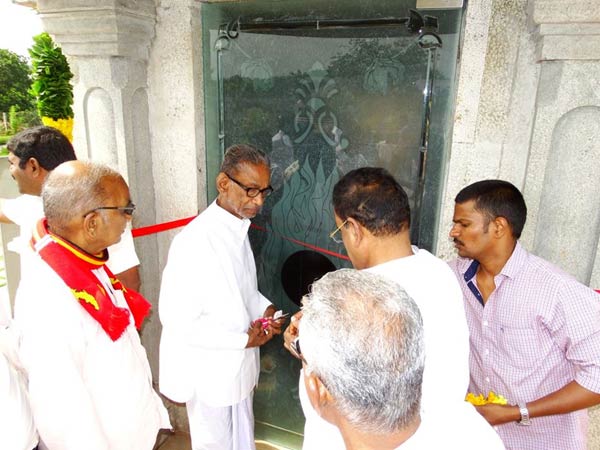
Visuvamadu Thuyilum Illam
Deep in the interior of the Mullaitivu district, away from the main highways and the coastal settlements, the town of Visuvamadu sits amid the dense scrubland and forests of the Vanni. This is a landscape of red laterite earth, thorny undergrowth, and vast open skies — a land that shaped the character of the Tamil liberation struggle as much as any battlefield. It was here, in this remote and resolute place, that the Visuvamadu Thuyilum Illam stood as a testament to the sacrifices made by Tamil fighters in the Vanni theatre.
The Vanni Heartland
The Vanni was the strategic and emotional heartland of the Tamil liberation movement. Its vast, sparsely populated terrain provided the depth that the narrow Jaffna peninsula could not. The battles fought in the Vanni were often gruelling — long engagements in difficult terrain against a numerically superior Sri Lankan military. The fighters buried at Visuvamadu had fallen in these engagements. They were men and women who had fought in the jungles and along the supply routes that kept the Tamil administration functioning. Many had operated far from their home villages, giving their lives in a region where the war’s daily reality was measured in ambushes, artillery barrages, and long patrols through unforgiving bush.
The Visuvamadu Thuyilum Illam, like all the Sleeping Houses, was maintained to an exacting standard. The headstones stood in precise formation. The grounds were cleared and planted. The eternal flame emblem marked each grave. Families from across the Vanni would travel to visit — sometimes on foot along jungle tracks, sometimes by bicycle on rutted roads — to tend the graves of their fallen.
The Erasure
The destruction of the Visuvamadu Thuyilum Illam followed the same pattern seen across the Tamil homeland. After the military’s advance through the Vanni in late 2008 and early 2009, the entire region came under total military control. Civilians were expelled or confined to camps. The Thuyilum Illam was demolished. Headstones were smashed and scattered. The grounds were flattened. In the isolation of the Vanni interior, far from any international observers, the destruction was carried out with impunity.
For the families of the Vanni, many of whom had already been displaced multiple times by the advancing military, the loss of the cemetery compounded an already unbearable grief. Displacement had torn them from their homes. The destruction of the Thuyilum Illam tore them from their dead. There was nowhere left to go, and nowhere left to mourn.
Today
Visuvamadu today is a place of profound quiet. The military presence in the Vanni interior has diminished somewhat over the years, but the scars of the conflict are everywhere — in the overgrown foundations of destroyed buildings, in the patches of jungle that have reclaimed former settlements, and in the empty ground where the Thuyilum Illam once stood. There are no markers. The Sri Lankan state has made no effort to acknowledge what was here. The silence is enforced.
Yet on November 27, Maaveerar Naal, the silence breaks in homes across the Vanni. Families light oil lamps. Photographs of the fallen are brought out and garlanded. Prayers are whispered. The ritual of remembrance continues in defiance of everything that has been done to suppress it. The Maaveerar of Visuvamadu are not forgotten. They will never be forgotten.
A Note to Visitors
Travelling to Visuvamadu requires commitment. The roads are poor, the infrastructure minimal, and the area remote. But visiting the Vanni interior offers something that the more accessible sites cannot — an encounter with the landscape itself, the vast and unforgiving terrain where so much of the Tamil liberation war was fought. Standing at the site of the Visuvamadu Thuyilum Illam, surrounded by the silence of the bush, you may begin to understand the depth of what was sacrificed here and the magnitude of what was destroyed.